Forex Backtesting vs. Live Trading: Can You Trust Your Backtest Results?
Spending many hours every day backtesting a Forex EA, creating the best set files based on the results, loading them onto a live account, and then finding completely different results the next day. Why does this happen? How should you test your EA’s performance? Is backtesting useless? What type of EA can be backtested? And how important is modeling quality—90%, 99%, or 99.99%?
Today, I am going to answer all these questions about backtesting vs. reality and explain a practical method for testing your Forex EA.
Many users depend on backtest results when deciding whether to use or reject a Forex EA. But before you continue relying on backtesting, you need to understand what a backtest actually does and how closely its results can match live trading.
How Close Can Backtesting Be to Live Trading?
It depends on the type of EA and the strategy it uses.
Some EAs use a fixed Forex strategy that repeatedly follows the same algorithm based on simple mathematical calculations. Other EAs change their strategy depending on market conditions, account conditions, and the performance of different trading pairs.
When you backtest an EA that uses a fixed algorithm, the results can often be relatively close to live trading. However, they will never be 100% identical.
This is because, regardless of whether you use 90%, 99%, or 99.99% modeling quality, real market factors such as slippage, broker latency, spread, and order execution can have a major impact on the final results.
That is why you should not expect backtest results to match live trading results exactly.
Backtesting Multi Pair and Adaptive EAs
Now consider an EA such as a Hedge Scalper EA, Correlation EA, or AI Trend EA that changes its strategy depending on market conditions and account load.
Such EAs may also compare different trading pairs to determine which pair is performing better or worse and then adjust their strategy accordingly.
When you backtest this type of EA, the results can be much further from real live performance. The main reason is that a typical backtest tests one trading pair at a time, while live trading can involve many trading pairs simultaneously.
For example, the EA may decide which pair should be used for hedging, which target to use, or which pair is currently performing best based on the performance of multiple pairs. This type of decision making cannot be fully reproduced when testing only a single pair.
The same applies to account load and win rate. In live trading, these values are combined across all trading pairs, while a single pair backtest only represents that individual pair.
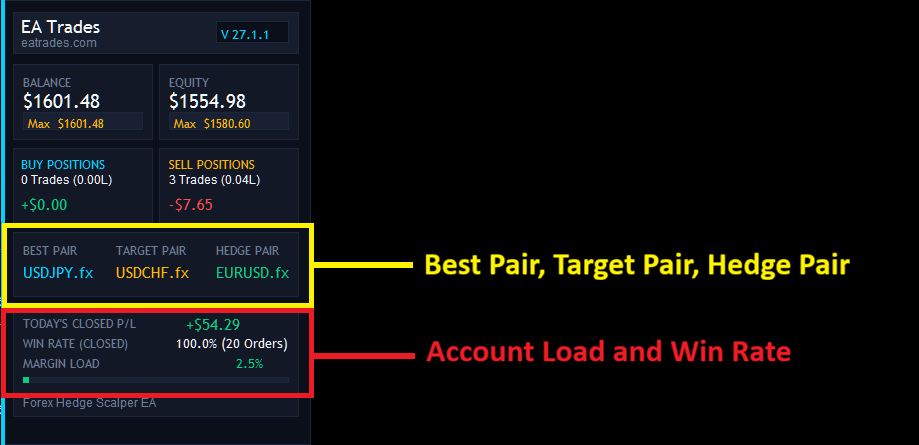
As shown in the image above, the EA is deciding its hedge pair, target, and best performing pair based on the performance of multiple pairs. This is difficult to reproduce accurately in a single pair backtest.
If Backtesting Is Not 100% Accurate, Why Is It Useful?
Actually, backtesting is very important for every EA and indicator. It helps you test whether the EA is working correctly, whether there are any errors, and whether the strategy is following its intended logic.
Using an EA without backtesting can result in a waste of both time and money because the EA may contain errors or may not behave according to the expected strategy.
However, depending 100% on backtest results is not a good idea.
What Is the Best Way to Test an EA?
The best method is to test the EA on a demo account using conditions as close as possible to your planned live account.
Ideally, use the same broker, same account balance, same leverage, and the same trading pairs that you plan to use on your live account.
Let the EA run for at least a month or more. The goal is to see how it performs during different market conditions, including trends, channels, and sideways markets.
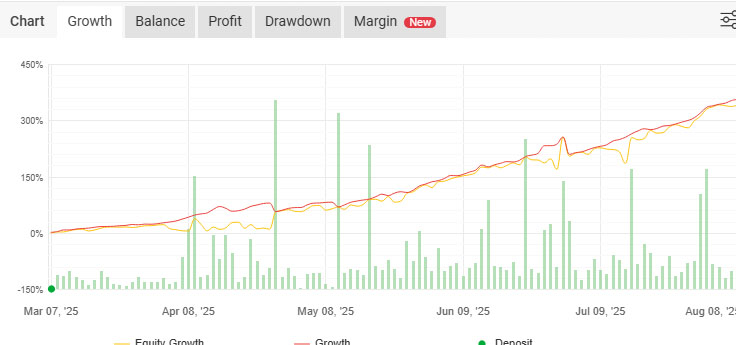
If you don’t want to spend that much time forward testing the EA yourself, ask the EA provider for an investor login or a Myfxbook link.
This is why EA Trades runs its EAs on live accounts and connects them to Myfxbook, allowing users to see how the EAs perform under real market conditions over time.
Main Differences Between Backtesting and Live Trading
Tick Counts
If you are backtesting an EA on the H1 timeframe, the market may have moved through around 2,000 ticks in live trading, while the backtest may simulate only around 400–600 ticks, depending on the data and testing method.
This can create differences in how the EA’s trades are executed.
Single Pair vs. Multiple Pairs
The Strategy Tester can test a single trading pair, while a live account can run the EA on multiple pairs at the same time.
For EAs that make decisions based on the performance of multiple pairs, this can create a significant difference between backtest and live results.
Market Data vs. Real Time Market
Backtesting uses historical market data, while live trading uses real time market conditions. The market can behave differently in live trading because of changing spreads, liquidity, volatility, and execution conditions.
Spread and Trading Costs
The spread in a backtest may not be exactly the same as the spread you receive in live trading. This can have a significant impact, especially on EAs that open many trades.
Slippage and Order Execution
In backtesting, trades are simulated using historical prices. In live trading, orders can experience slippage and different execution prices because the market is moving in real time.
Broker Latency
The time it takes for an order to reach and be executed by the broker can also affect live results. This is another factor that a backtest cannot perfectly reproduce.
Conclusion
Backtesting is not useless, but you should not treat backtest results as a guarantee of live performance.
A backtest is useful for understanding how an EA behaved under historical conditions and for identifying whether the strategy is working as expected. However, real trading includes factors such as spread, slippage, latency, execution, and multiple pair account conditions that can make live results different.
For this reason, the best approach is to use backtesting first, followed by forward testing on a demo account and, where possible, verified live trading results.
The closer your testing conditions are to your actual live trading environment, the more useful your backtest results will be.